
Every Indian automotive dealership starts with Excel. It is familiar, it is already installed, and it feels like the fastest way to get organised. You create one sheet for leads, another for test drives, and a third for vehicle stock. Your team knows how to use it, and for the first few months, it works fine.
But there comes a point when the spreadsheet stops being a solution and starts becoming the problem. The signs are subtle at first: a lead goes cold because nobody followed up, a customer asks about a vehicle that was sold three days ago, or you spend two hours every Monday manually updating reports. What began as a quick fix has quietly turned into your biggest operational bottleneck.
This comparison is not about whether Excel is a bad tool. It is about whether Excel is the right tool for running a growing dealership in India in 2026.
Why Excel Feels Like the Right Choice at First
Spreadsheets have genuine appeal for dealerships starting out or managing smaller operations. The reasons dealerships default to Excel are practical and valid.
There is no training required. Everyone in your team already knows how to enter data and create basic formulas. There are no login credentials to manage, no user licenses to pay for, and no vendor contracts to review.
Excel is flexible by design. You can add a column for “Finance Approved” or “Trade-in Value” in seconds. Need to track test drive feedback? Add another column. This freedom feels empowering when you are figuring out your workflow on the go.
Sharing is simple. A single Excel file or a Google Sheet can be accessed by the entire team. It feels like collaboration, at least on the surface.
And perhaps most importantly, Excel appears cost-effective. You already have Microsoft Office or Google Workspace. There is no additional software expense. For a dealership trying to conserve cash, this is a compelling argument .
But this is where the trap lies. What seems like a cost-saving measure at the start often becomes a revenue-draining liability as your dealership grows.

The Hidden Costs of Managing a Dealership on Excel
Excel is a spreadsheet. A dealership is a complex business with interconnected operations. The mismatch between the tool and the business creates costs that are not always visible on a balance sheet.
Lost Leads and Missed Follow-ups
A spreadsheet can store a date for the next follow-up, but it cannot remind your sales team when that date arrives. It cannot escalate a lead that has gone cold or track whether the promised call actually happened .
For Indian dealerships, this is particularly damaging. Customers today are comparing prices and availability across multiple dealers. A delayed response or a missed follow-up often means losing a sale to a competitor who replied faster.
Version Control Chaos
One salesperson updates a row. Another sorts the sheet by a different column. A manager copies tabs to create a monthly report. Within a few days, you have three different versions of the same file, and nobody knows which one is accurate . When accountability breaks down, lead leakage increases and managers lose confidence in their own pipeline numbers.
No Real-Time Visibility
For dealerships with multiple outlets, the Excel problem multiplies. Each location maintains its own spreadsheet. Reports are shared via email or WhatsApp. By the time the data reaches the leadership team, it is already outdated . Decisions are made on stale information, and opportunities are missed.
Inventory Inaccuracies
Stock updates are manual. Vehicles are marked as sold hours or sometimes days after the transaction. A customer walks in asking for a specific model and colour. Your team checks the spreadsheet and says it is available. The vehicle has already been sold, but the sheet was not updated . The result is a broken promise and a customer who may not return.
Manual Reporting Drains Manager Time
Managers spend hours every week cleaning data to answer basic questions: which lead source converts best, which salesperson is performing, and how many deals are in negotiation . This is time that could be spent coaching the team, reviewing sales strategies, or handling customer escalations.
Customer Experience Gaps
Customer history is scattered across Excel sheets, WhatsApp chats, and sticky notes. Every time a customer calls, your team asks them to repeat information that was already provided. The experience feels disjointed, and the customer notices .
What Dealership Management Software Delivers
A dedicated dealership management system is built for the specific needs of automotive retail. It addresses each of Excel’s weaknesses through design and automation.
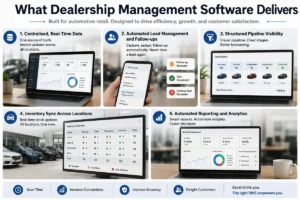
Centralised, Real-Time Data
A DMS provides a single source of truth. Sales, service, inventory, and finance data live in one platform. Updates are reflected instantly. Whether you have one showroom or thirty, leadership gets a unified view of the entire operation .
This is particularly valuable for dealership groups managing multiple locations. Instead of consolidating spreadsheets at month-end, you have live dashboards showing sales performance, inventory levels, and service utilisation across the network.
Automated Lead Management and Follow-ups
Leads are captured automatically from walk-ins, phone calls, and online portals. They are assigned to sales representatives based on rules. Follow-up reminders are generated automatically, and overdue tasks are escalated to managers .
The impact is measurable. Ather Energy implemented a new DMS and reported a reduction in lead capture time to just 45 to 60 seconds. Lead conversion improved significantly with better tracking and follow-up discipline .
Structured Pipeline Visibility
Instead of manually tracking which leads are at which stage, a DMS provides a visual pipeline. You can see at a glance how many leads are newly acquired, how many have taken test drives, how many are in negotiation, and how many are close to closure. Forecasting becomes data-driven rather than guesswork .
Inventory Sync Across Locations
Vehicle stock is updated in real time. When a vehicle is sold, the inventory reflects it immediately. For multi-location operations, you can see stock availability across all outlets from a single dashboard. This prevents overselling and builds customer trust .
Automated Reporting and Analytics
Instead of spending hours on manual reporting, DMS platforms generate reports automatically. Sales performance, lead source analysis, service revenue, and inventory turnover data are available on demand. This enables faster, more informed decision-making .
Excel vs DMS: A Side-by-Side Comparison
| Dealership Operation | Excel / Google Sheets | Dealership Management Software |
|---|---|---|
| Lead capture | Manual copy-paste, prone to errors | Automated capture from all channels |
| Lead assignment | Depends on discipline and manual updates | Rules-based automatic assignment |
| Follow-up reminders | Manual dates, no enforcement | Automated tasks, reminders, escalation |
| Test drive scheduling | Separate calendars, conflicts | Appointments linked to lead and vehicle |
| Deal stage tracking | Inconsistent across reps | Structured pipeline with visual dashboard |
| Inventory management | Manual updates, delayed visibility | Real-time sync across locations |
| Customer history | Scattered across sheets and apps | Centralised timeline of all interactions |
| Reporting | Manual, error-prone, delayed | Real-time, automated, customisable |
| Team accountability | Difficult to track ownership | Clear audit trail with ownership records |
Real-World Indian Context: Dealerships Moving Beyond Excel
The shift from spreadsheets to DMS is not theoretical. Major players in the Indian automotive market are making decisive moves.
Mercedes-Benz India partnered with Zoho to develop SKYLine, a bespoke DMS built entirely in India over two years. The platform digitises the entire service lifecycle across the company’s nationwide dealership network. Each dealership operates on its own Zoho CRM instance, providing dealer-level autonomy while maintaining compliance with Mercedes-Benz’s global standards .
SKYLine was rolled out with over 5,000 man-days of user acceptance testing and 3,000 man-days of training, reflecting the seriousness with which established players treat their DMS investments .
Ather Energy, an Indian EV manufacturer, took a similar path. The company unified its dealer operations on Salesforce, building a comprehensive DMS that transformed sales, service, training, and reporting. The platform reduced dealer ramp-up time from over a week to just a few hours, eliminating a long-standing challenge in the industry .
These examples show that as dealerships scale and customer expectations rise, spreadsheets become inadequate. The question is not whether to move to a DMS, but when.

When Should Your Dealership Switch?
You do not switch from Excel to a DMS because it is trendy. You switch when your current system cannot keep up with your operations.
Here are clear indicators that it is time to move:
-
Leads are being lost before test drives because follow-ups are inconsistent.
-
Your sales team has grown beyond four or five members, and ownership and handoffs are breaking in sheets.
-
You cannot answer pipeline questions quickly. Asking “How many are in negotiation?” takes hours instead of seconds.
-
Test drive scheduling is messy with conflicts, no reminders, and no feedback capture.
-
Finance and approvals are slowing down deals because discount approvals, trade-in approvals, and finance status are not tracked cleanly.
-
Your team relies heavily on WhatsApp for customer communication. History lives in personal phones, creating risk when staff members leave.
If two or more of these points describe your dealership, a DMS is not additional software. It is your next operational layer .
Why Dedicated DMS Platforms Are the Answer
Modern DMS platforms are built specifically for dealership workflows. They are not generic CRMs adapted for automotive retail. They understand the nuances: vehicle interest versus vehicle inquiry, test drive scheduling with vehicle availability, trade-in valuation workflows, and finance approval tracking.
For Indian dealerships, compliance with GST filing and government reporting requirements can be embedded directly into the platform. Instead of manually preparing reports for regulatory submissions, the DMS generates them automatically .
The total cost of ownership, when factoring in the cost of missed follow-ups, lost leads, manager time, and inventory mistakes, often makes the DMS the more economical choice in the long run.
DealerSetu
For Indian dealerships seeking a modern, affordable, and India-specific solution, DealerSetu offers a comprehensive platform built around CRM, sales automation, and inventory management. It addresses the specific needs of Indian automotive dealerships, helping them move beyond spreadsheets to a system designed for growth.
Frequently Asked Questions
Can Excel ever be better than a DMS?
Excel is better when a dealership is very small, with a handful of vehicles and a single location. It is also useful for ad hoc analysis like profitability calculations. However, as soon as lead volume, team size, or inventory complexity grows, Excel becomes a liability.
Is Google Sheets better than Excel for managing dealerships?
Google Sheets is better for collaboration and version control than local Excel files. But it still cannot enforce follow-ups, automate lead assignment, or provide real-time pipeline visibility. It is a better spreadsheet, not a DMS .
How long does it take to implement a DMS?
Implementation time depends on dealership size, data migration requirements, and customisation needs. Small dealerships may go live in a few weeks, while larger groups with complex integrations may take several months.
Will a DMS help me sell more vehicles?
Indirectly, yes. A DMS improves lead management, response times, customer relationship tracking, and data-driven decision making. By automating routine tasks, it frees your sales team to focus on selling rather than administration.
Can I keep Excel for analysis after switching to a DMS?
Yes. Many dealerships keep Excel for ad hoc analysis or one-off reports. The key is to stop using it as the system of record for leads, follow-ups, and deal stages. Once your operational data lives in the DMS, you can export it to Excel for custom analysis without losing the benefits of a structured system .
How do I move from a dealership spreadsheet to a DMS?
Start by mapping your real workflow—not your ideal one. Clean your spreadsheet data before migration. Define the minimum required fields (vehicle interest, budget, financing preference, trade-in details, source, and next follow-up date). Import in phases, starting with active leads from the last 60 to 90 days. Run a two-week parallel period with the spreadsheet kept read-only while the team works in the DMS .
What are the most important DMS features for Indian dealerships?
For Indian dealerships, GST compliance, regional language support, WhatsApp integration, mobile accessibility, and multi-location reporting are critical. The platform should also handle the specific workflows of two-wheeler, passenger vehicle, and commercial vehicle dealerships.
Making the Switch
Excel got your dealership started because it is flexible and familiar. But growth changes the job. You are no longer just tracking leads. You are running a repeatable sales machine across multiple sales representatives, vehicles, test drives, and finance steps.
Switching to a DMS is not about abandoning Excel entirely. It is about upgrading your operating system so follow-ups happen on time, pipeline visibility is real, and your team spends more time selling and less time updating cells.
The cost of staying on spreadsheets is rarely the Excel license. It is the compounding cost of missed actions, slow handoffs, and invisible pipeline risk. As your dealership grows, the spreadsheets that once seemed manageable will become your biggest barrier to scaling.
DealerSetu is designed for Indian dealerships ready to move beyond spreadsheets and into a system built for growth. The right DMS is not a cost. It is an investment in your dealership’s future.