The math of selling cars in India has always been thin. Most passenger vehicle dealers operate on margins of 2.9% to 7.5% on vehicle cost, with the average hovering around 3.5% of the sale price. Spare parts offer better margins at 15–20%, but the core business runs on wafer‑thin numbers. When every percentage point matters, discount leakage is not a minor operational hiccup. It is a direct assault on survival.
Discount leakage happens when your dealership gives away more margin than intended, authorised, or tracked. It shows up in multiple forms: unauthorised price cuts by sales executives, unapproved discounts in the service department, excessive freebies that eat into profitability, and inconsistent pricing across branches. Each instance seems small in isolation. A ₹200 discount here. A ₹500 free accessory there. A “special festive offer” that no one approved. Over a month, across hundreds of transactions, these small leaks drain lakhs of rupees from your bottom line.
Indian dealerships are under unprecedented pressure. Inventory levels across several segments are hovering at 52–53 days, significantly above the healthy benchmark of 30–35 days. An estimated ₹52,000 crore worth of vehicles remain unsold. Dealers are forced to offer steep discounts to clear ageing stock. ICRA projects operating margins to moderate by 40–70 basis points in FY2025 owing to higher discounts. In this environment, every rupee of unmanaged discount is a rupee of profit you cannot afford to lose.
The question is not whether discount leakage exists in your dealership. The question is whether you can see it.
What Is Discount Leakage in an Automobile Dealership?
Discount leakage is the gap between the profit you should make on a transaction and the profit you actually make. It is the margin that disappears because discounts are offered without proper authorisation, tracking, or reconciliation.
This is different from strategic discounting. Strategic discounts are planned, budgeted, and approved. They serve a clear purpose: clearing specific inventory, matching competitor offers, or driving volume during festive seasons. Discount leakage is unplanned, unauthorised, and often invisible until the monthly P&L statement arrives.
In Indian dealerships, discount leakage hides in plain sight. A sales executive offers an extra ₹5,000 discount to close a deal without seeking manager approval. A service advisor gives a “courtesy discount” on a paid service to keep a customer happy. A branch manager runs a local promotional offer that is not aligned with corporate pricing policy. None of these actions are malicious. They are often well‑intentioned efforts to satisfy customers or close sales. But without a system to track, approve, and audit every discount, these well‑intentioned actions collectively destroy profitability.
The Many Faces of Discount Leakage in Indian Dealerships
Discount leakage does not announce itself. It operates through multiple channels across your dealership. Understanding where it hides is the first step toward controlling it.

Unauthorised Sales Discounts
This is the most common form of discount leakage. Sales executives, under pressure to meet monthly targets, offer additional discounts beyond approved limits. The discount might be framed as a “special price” for a serious buyer or a “festive gesture.” Without real‑time visibility into approval workflows, these discounts go unnoticed until the deal is closed and the margin is already lost.
The challenge is particularly acute during high‑volume periods like festive seasons, when dealers offer an additional 2–3% in discounts and incentives to move stock. Without strict approval controls, the line between planned discounting and margin erosion blurs quickly.
Service Department Discount Leakage
The service department is often treated as the dealership’s profit fortress. But discount leakage operates here too. Service advisors offer discounts on labour hours or parts to retain customers. Points redemption ledgers become tools for unauthorised adjustments. A ₹100–200 discount on a paid service might not seem significant, but over hundreds of service transactions, the cumulative impact is substantial. When discounts are offered without General Manager approval, the leakage becomes systemic.
Inventory-Driven Forced Discounting
This is the most painful form of discount leakage because it is driven by external pressure rather than internal laxity. When inventory piles up, carrying costs rise. Financing charges, insurance, and storage costs eat into already thin margins. Dealers panic and slash prices, often selling vehicles at or below invoice price, hoping to recover losses through manufacturer volume bonuses that may never materialise.
Freebies and Accessories as Hidden Discounts
Discounts are not always cash reductions. Free accessories, extended warranties, complimentary services, and other add‑ons are also discounts in disguise. When sales teams offer freebies without tracking their cost impact, these “customer goodwill” gestures become profit leaks.
Inconsistent Pricing Across Branches
For multi‑branch dealership groups, inconsistent pricing is a major source of leakage. Different showroom managers interpret discount policies differently. One branch offers deeper discounts to achieve its targets, creating pricing disparities that customers notice and exploit. Without centralised visibility and control, each branch operates as its own profit centre, and the group bears the cumulative cost.
The True Cost of Discount Leakage
Discount leakage is not just about individual transactions. Its real cost compounds across your entire operation.
Margin erosion: When operating margins are already under pressure (ICRA expects them to moderate by 40–70 bps in FY2025), every additional percentage point of unauthorised discount directly hits net profit.
Working capital strain: Dealerships already face working capital challenges. The industry is sitting on approximately ₹52,000 crore worth of unsold vehicles. When discounts erode margins, the ability to service inventory financing and maintain cash flow weakens further.
Customer expectation reset: Once customers receive deep discounts, they expect them every time. This forces dealers into a cycle of continuous discounting, making it increasingly difficult to restore margins.
Operational inefficiency: When discount approval processes are manual or non‑existent, management time is spent firefighting rather than strategising. Sales teams waste time negotiating discounts rather than selling value.
Fraud vulnerability: Weak discount controls create opportunities for fraud. The Rajasthan vehicle scrappage scam, where a dealer allegedly pocketed ₹50,000 to ₹1 lakh per vehicle through fraudulent use of government discounts, is a stark reminder of what happens when discount processes lack transparency.
Why Manual Processes Fail to Control Discount Leakage
Most Indian dealerships still rely on Excel sheets, WhatsApp messages, and verbal approvals to manage discounts. This approach fails for several reasons:
No real‑time visibility: By the time discount data is compiled in Excel and shared with management, the transactions are already closed. You cannot recover margin that has already been given away.
Inconsistent enforcement: Without a centralised system, different managers apply different standards. One showroom manager approves every discount request; another approves none. Customers quickly learn which branch offers better deals.
No audit trail: Verbal approvals and informal arrangements leave no record. When questions arise about profitability, there is no way to trace how discounts were authorised or who approved them.
Delayed reporting: Monthly MIS reports compiled manually arrive too late to enable corrective action. By the time you see the leakage, the damage is done.
Branch‑level fragmentation: For multi‑branch dealerships, each location maintains its own records. There is no consolidated view of discount patterns across the group.
If you recognise these challenges in your dealership, see how DealerSetu automates discount approvals and gives you real‑time control.
How Technology Brings Discount Leakage Under Control
Controlling discount leakage requires moving from reactive, after‑the‑fact reporting to proactive, real‑time control. This is where a comprehensive automobile dealership ERP system becomes essential.
Automated Approval Workflows
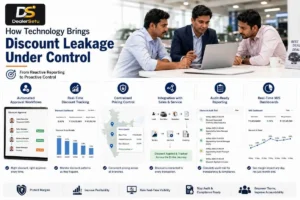
A dealership ERP system enables multi‑level approval workflows for discounts. Discount requests can be configured to escalate based on percentage slabs or amount thresholds. A 2% discount might require sales manager approval; a 5% discount might need general manager authorisation; anything beyond that escalates to the dealer principal. This ensures that every discount is approved by the right person before it is offered, not discovered after the fact.
Real-Time Discount Tracking
With a dealership management system, every discount is tracked in real time. Sales teams can see the available discount budget for each model. Management can monitor discount patterns across branches, models, and sales executives as they happen. This visibility enables course correction before margins are eroded, not after.
Centralised Pricing Control
For multi‑branch dealership groups, a centralised ERP system ensures consistent pricing across all locations. Branch managers cannot independently alter discount policies. Any deviation requires approval and is tracked centrally. This prevents the pricing disparities that customers exploit and protects group‑level profitability.
Integration with Sales and Service Processes
When discount management is integrated with the broader dealership workflow (lead tracking, test drive scheduling, service appointments, and invoicing), discount leakage becomes visible across the entire customer journey. A discount offered during the sales process flows through to invoicing. A service discount is linked to the specific job card. Every discount is tied to a transaction, a customer, and an approver.
Audit-Ready Reporting
A dealership ERP system maintains a complete audit trail of every discount approved, offered, and applied. This is not just about internal control; it also prepares your dealership for audits and compliance reviews. When questions arise about discount practices, you have the data to answer them.
Real-Time MIS Dashboards
Modern dealership management solutions provide real‑time MIS dashboards that show discount patterns, margin impact, and branch‑level performance. Instead of waiting for end‑of‑month reports, dealer principals can see exactly how discounts are affecting profitability on any given day.
The Role of Dealership ERP in Preventing Discount Leakage
A robust automobile dealership ERP is the foundation of discount leakage prevention. It replaces fragmented manual processes with an integrated system that brings visibility, control, and accountability to every discount decision.
DealerSetu is designed specifically for Indian automobile dealerships, addressing the unique challenges of the Indian market. With features like real‑time discount tracking, multi‑level approval workflows, centralised branch management, and integrated MIS reporting, DealerSetu helps dealerships plug the leaks that drain profitability.
DealerSetu provides a single platform to manage sales, service, inventory, accounting, and customer relationships. Every discount is tracked. Every approval is recorded. Every branch is visible. This is not about restricting your sales team’s ability to close deals. It is about ensuring that every discount you offer is intentional, approved, and accounted for.
Discover how DealerSetu can help you plug every discount leak across branches.
From Discount Leakage to Discount Intelligence
The goal is not to eliminate discounts. Discounts are a legitimate business tool. The goal is to move from discount leakage to discount intelligence, where every discount is deliberate, tracked, and measured against its business impact.

Discount intelligence means knowing:
-
Which models require the deepest discounts to move
-
Which sales executives offer the most discounts and whether their conversion rates justify them
-
Which branches are discounting more than others and why
-
Whether discounts are actually driving incremental sales or simply eroding margin on deals that would have closed anyway
This level of insight is impossible with Excel sheets and manual reporting. It requires a dealership management system that captures every transaction and provides real‑time analytics.
The Indian Context: Why This Matters Now
The Indian automobile retail sector is navigating one of its most challenging periods. Inventory levels are at record highs. Dealers are sitting on ₹52,000 crore worth of unsold vehicles. Operating margins are under pressure from both rising costs and forced discounting. Regulatory changes like GST 2.0 have created additional working capital stress, with dealers facing potential losses of approximately ₹2,500 crore.
In this environment, discount leakage is not a theoretical concern. It is a daily reality that determines whether a dealership stays profitable or slips into the red. Dealers who cannot control their discounts will struggle to survive the current squeeze. Those who implement systems to track, approve, and manage every discount will protect their margins and emerge stronger.
The Competition Commission of India’s action against Maruti Suzuki (imposing a ₹200 crore penalty for restricting dealer discounts) highlights how sensitive the discount issue is in the Indian market. Dealers must navigate between manufacturer policies, competitive pressure, and their own profitability. A dealership ERP system provides the data and control needed to make informed decisions in this complex environment.
Building a Discount Control Culture
Technology enables discount control, but culture sustains it. Building a discount control culture requires:
Clear discount policies: Every employee should know what discounts are permitted, who can approve them, and what the approval process is. Ambiguity creates leakage.
Accountability: Sales executives and branch managers should be measured not just on volume but on margin protection. When people are accountable for profitability, discount decisions become more thoughtful.
Transparency: When discount data is visible to everyone (within appropriate access levels), it creates healthy peer pressure. No one wants to be the branch with the highest discount‑to‑sales ratio.
Training: Sales teams need to understand the margin impact of discounts. When a sales executive knows that a ₹10,000 discount wipes out a significant portion of the dealership’s profit, they negotiate differently.
Continuous improvement: Regular review of discount patterns helps identify emerging issues. Are discounts creeping up in certain models? Are certain salespeople consistently offering more discounts? These patterns can be addressed before they become systemic.
Have specific questions about discount control for your dealership? Talk to our experts at DealerSetu for a custom walkthrough.
FAQ
1. What exactly is discount leakage in an automobile dealership?
Discount leakage is the loss of profit that occurs when discounts are offered without proper authorisation, tracking, or reconciliation. It includes unauthorised price cuts, unapproved service discounts, excessive freebies, and inconsistent pricing across branches. Every discount that reduces your margin without being planned, approved, and tracked is a leak.
2. How much profit do Indian car dealers typically make per vehicle?
Indian passenger vehicle dealers typically operate on margins of 2.9% to 7.5% on vehicle cost, with the average around 3.5% of the sale price. Spare parts offer better margins at 15–20%. With such thin margins, even small discount leaks significantly impact profitability.
3. Why are Indian dealerships offering so many discounts right now?
Dealerships are sitting on unsold inventory worth approximately ₹52,000 crore, with inventory levels at 52–53 days against a healthy benchmark of 30–35 days. High carrying costs force dealers to offer steep discounts to clear ageing stock, further eroding margins.
4. How can a dealership ERP system help control discount leakage?
A dealership ERP system enables automated approval workflows, real‑time discount tracking, centralised pricing control across branches, integrated sales and service processes, and audit‑ready reporting. It replaces manual, fragmented processes with a system that brings visibility and accountability to every discount decision.
5. What is the difference between strategic discounting and discount leakage?
Strategic discounting is planned, budgeted, and approved. It serves a clear purpose like clearing specific inventory or matching competitor offers. Discount leakage is unplanned, unauthorised, and often invisible until the monthly P&L arrives. Strategic discounting is a tool; discount leakage is a cost.
6. Can discount leakage happen in the service department too?
Yes. Service advisors may offer discounts on labour hours or parts without proper approval. Points redemption ledgers can be used for unauthorised adjustments. Small discounts on individual service transactions accumulate into significant leakage over time.
7. How do multi‑branch dealerships experience discount leakage differently?
Multi‑branch dealerships face inconsistent pricing across locations. Different showroom managers interpret discount policies differently, creating pricing disparities that customers notice and exploit. Without centralised visibility and control, each branch operates independently and the group bears the cumulative cost of discount leakage.
8. What should a dealership owner look for when choosing a dealership ERP system to control discounts?
Look for real‑time discount tracking, multi‑level approval workflows, branch‑wise reporting, integration with sales and service modules, and a centralised MIS dashboard. The system should also provide audit trails and allow configuration of discount policies per model, segment, or branch.
Conclusion
Discount leakage is not a cost of doing business. It is a cost of not running your business with the right systems. In an industry where net margins are measured in basis points, leaving discount control to manual processes and verbal approvals is a recipe for slow, silent profit erosion.
The current inventory glut and competitive pressure have made discounting inevitable. But inevitable discounting does not have to mean uncontrollable leakage. With a modern automobile dealership ERP like DealerSetu , you can bring every discount under visibility, approval, and accountability.
Stop discovering lost margins at month‑end. Start controlling them in real time. The difference between surviving and thriving in today’s Indian auto retail market often comes down to how well you manage the small leaks. Plug them, and your profitability will show the difference.
Start protecting your margins today.