
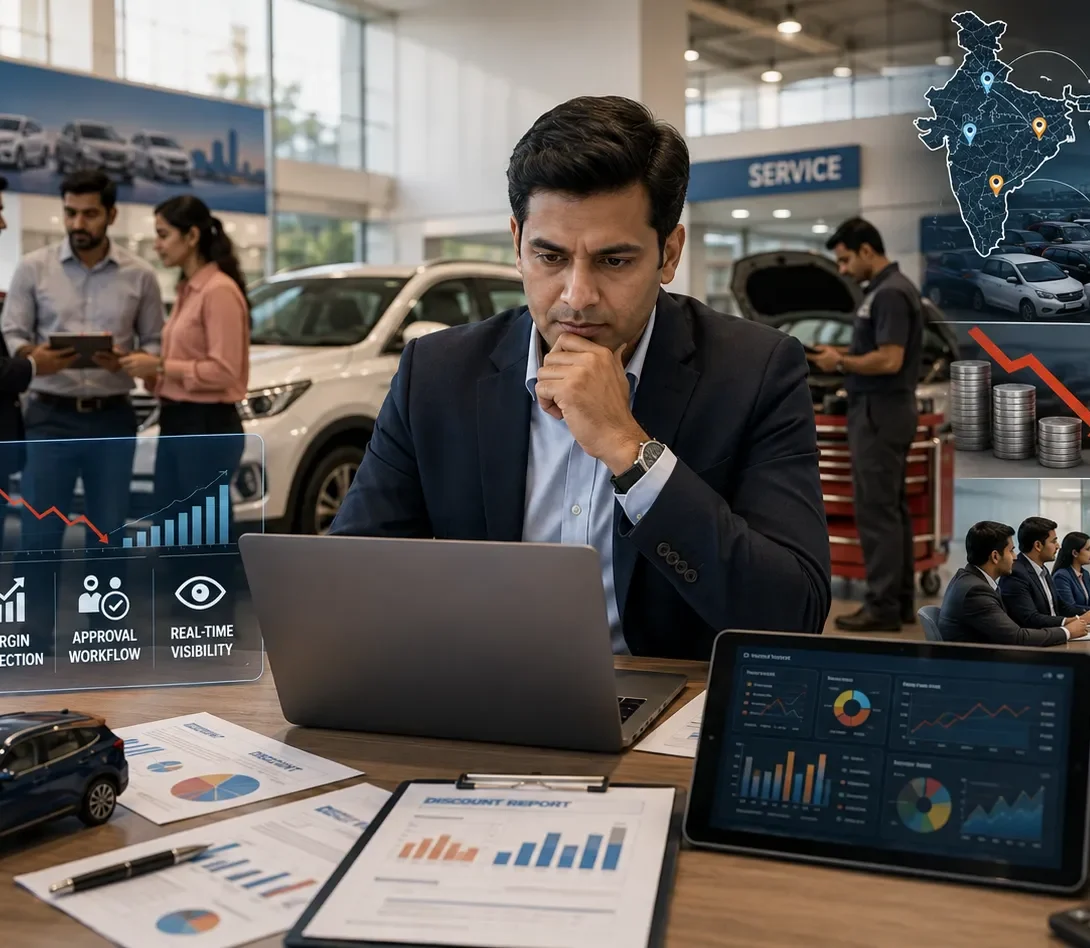
The math of selling cars in India has always been thin. Most passenger vehicle dealers operate on margins of 2.9% to 7.5% on vehicle cost, with the average hovering around 3.5% of the sale price. Spare parts offer better margins at 15–20%, but the core business runs on wafer‑thin numbers. When every percentage point matters, discount leakage is not a minor operational hiccup. It is a direct assault on survival. Discount leakage happens when your dealership gives away more margin than intended, authorised, or tracked. It shows up in multiple forms: unauthorised price cuts by sales executives, unapproved discounts in the service department, excessive freebies that eat into profitability, and inconsistent pricing across branches. Each instance seems small in isolation. A ₹200 discount here. A ₹500 free accessory there. A “special festive offer” that no one approved. Over a month, across hundreds of transactions, these small leaks drain lakhs of rupees from your bottom line. Indian dealerships are under unprecedented pressure. Inventory levels across several segments are hovering at 52–53 days, significantly above the healthy benchmark of 30–35 days. An estimated ₹52,000 crore worth of vehicles remain unsold. Dealers are forced to offer steep discounts to clear ageing stock. ICRA projects operating margins to moderate by 40–70 basis points in FY2025 owing to higher discounts. In this environment, every rupee of unmanaged discount is a rupee of profit you cannot afford to lose. The question is not whether discount leakage exists in your dealership. The question is whether you can see it. What Is Discount Leakage in an Automobile Dealership? Discount leakage is the gap between the profit you should make on a transaction and the profit you actually make. It is the margin that disappears because discounts are offered without proper authorisation, tracking, or reconciliation. This is different from strategic discounting. Strategic discounts are planned, budgeted, and approved. They serve a clear purpose: clearing specific inventory, matching competitor offers, or driving volume during festive seasons. Discount leakage is unplanned, unauthorised, and often invisible until the monthly P&L statement arrives. In Indian dealerships, discount leakage hides in plain sight. A sales executive offers an extra ₹5,000 discount to close a deal without seeking manager approval. A service advisor gives a “courtesy discount” on a paid service to keep a customer happy. A branch manager runs a local promotional offer that is not aligned with corporate pricing policy. None of these actions are malicious. They are often well‑intentioned efforts to satisfy customers or close sales. But without a system to track, approve, and audit every discount, these well‑intentioned actions collectively destroy profitability. The Many Faces of Discount Leakage in Indian Dealerships Discount leakage does not announce itself. It operates through multiple channels across your dealership. Understanding where it hides is the first step toward controlling it. Unauthorised Sales Discounts This is the most common form of discount leakage. Sales executives, under pressure to meet monthly targets, offer additional discounts beyond approved limits. The discount might be framed as a “special price” for a serious buyer or a “festive gesture.” Without real‑time visibility into approval workflows, these discounts go unnoticed until the deal is closed and the margin is already lost. The challenge is particularly acute during high‑volume periods like festive seasons, when dealers offer an additional 2–3% in discounts and incentives to move stock. Without strict approval controls, the line between planned discounting and margin erosion blurs quickly. Service Department Discount Leakage The service department is often treated as the dealership’s profit fortress. But discount leakage operates here too. Service advisors offer discounts on labour hours or parts to retain customers. Points redemption ledgers become tools for unauthorised adjustments. A ₹100–200 discount on a paid service might not seem significant, but over hundreds of service transactions, the cumulative impact is substantial. When discounts are offered without General Manager approval, the leakage becomes systemic. Inventory-Driven Forced Discounting This is the most painful form of discount leakage because it is driven by external pressure rather than internal laxity. When inventory piles up, carrying costs rise. Financing charges, insurance, and storage costs eat into already thin margins. Dealers panic and slash prices, often selling vehicles at or below invoice price, hoping to recover losses through manufacturer volume bonuses that may never materialise. Freebies and Accessories as Hidden Discounts Discounts are not always cash reductions. Free accessories, extended warranties, complimentary services, and other add‑ons are also discounts in disguise. When sales teams offer freebies without tracking their cost impact, these “customer goodwill” gestures become profit leaks. Inconsistent Pricing Across Branches For multi‑branch dealership groups, inconsistent pricing is a major source of leakage. Different showroom managers interpret discount policies differently. One branch offers deeper discounts to achieve its targets, creating pricing disparities that customers notice and exploit. Without centralised visibility and control, each branch operates as its own profit centre, and the group bears the cumulative cost. The True Cost of Discount Leakage Discount leakage is not just about individual transactions. Its real cost compounds across your entire operation. Margin erosion: When operating margins are already under pressure (ICRA expects them to moderate by 40–70 bps in FY2025), every additional percentage point of unauthorised discount directly hits net profit. Working capital strain: Dealerships already face working capital challenges. The industry is sitting on approximately ₹52,000 crore worth of unsold vehicles. When discounts erode margins, the ability to service inventory financing and maintain cash flow weakens further. Customer expectation reset: Once customers receive deep discounts, they expect them every time. This forces dealers into a cycle of continuous discounting, making it increasingly difficult to restore margins. Operational inefficiency: When discount approval processes are manual or non‑existent, management time is spent firefighting rather than strategising. Sales teams waste time negotiating discounts rather than selling value. Fraud vulnerability: Weak discount controls create opportunities for fraud. The Rajasthan vehicle scrappage scam, where a dealer allegedly pocketed ₹50,000 to ₹1 lakh per vehicle through fraudulent use of government discounts, is a stark reminder of what happens when discount processes lack transparency. Why Manual Processes Fail