
CRM vs DMS for Auto Dealers: Which One Does Your Dealership Really Need?
Many automobile dealerships begin their digital journey by investing in software. Some start with a Customer Relationship Management (CRM) system to organize leads and improve follow-ups. Others invest in a Dealer Management System (DMS) to manage inventory, billing, accounting, and day-to-day operations.
The challenge begins when dealership owners assume that both systems perform the same role.
Although CRM and DMS work closely together, they solve very different business problems. Choosing the wrong software can create operational gaps, duplicate work, and unnecessary expenses. Understanding how each system works helps dealerships invest in technology that supports both immediate requirements and future growth.
This guide explains the differences between CRM and DMS, where each solution adds value, and why many successful dealerships eventually use both as part of a connected dealership ecosystem.
What is a CRM for Auto Dealers?
A Customer Relationship Management system focuses on customers and sales activities.
Its primary objective is to help dealerships attract leads, manage enquiries, improve follow-ups, and increase vehicle sales.
A good dealer CRM software stores customer information in one place, making it easier for sales teams to understand buyer preferences and maintain communication throughout the sales journey.
Typical CRM features include:
- Lead capture from websites and campaigns
- Sales enquiry management
- Follow-up reminders
- Customer communication history
- Test drive scheduling
- Sales pipeline management
- Lead assignment
- Customer retention activities
For dealerships investing in digital marketing, a CRM ensures that every lead receives timely attention.
What is a Dealer Management System (DMS)?
A dealer management system is designed to manage the complete operations of an automobile dealership.
While CRM focuses on customer relationships, a DMS manages the business behind every sale.
Modern dealership management software connects multiple departments on one platform, allowing dealerships to operate efficiently without relying on disconnected systems.
A typical DMS includes:
- Vehicle inventory management
- Sales management
- Dealer CRM
- Finance and Insurance
- Accounting
- GST billing
- Workshop management
- Spare parts inventory
- Warranty tracking
- Multi-branch management
- Employee performance
- Reports and dashboards
Instead of switching between multiple applications, dealership teams work from one centralized system.
CRM vs DMS: Understanding the Core Difference
The easiest way to understand the difference is by looking at their primary purpose.
A CRM answers the question:
“How can we sell more vehicles?”
A DMS answers the question:
“How do we manage the entire dealership efficiently?”
CRM is primarily customer-focused.
DMS is business-focused.
CRM helps generate revenue through better customer engagement.
DMS helps improve profitability by streamlining operations across departments.
Rather than replacing each other, both systems complement one another.
Feature Comparison
| Feature | CRM | DMS |
|---|---|---|
| Lead Management | ✔ | ✔ |
| Customer Database | ✔ | ✔ |
| Vehicle Inventory | ✘ | ✔ |
| Billing & Invoicing | ✘ | ✔ |
| GST Management | ✘ | ✔ |
| Accounting | ✘ | ✔ |
| Service Workshop | ✘ | ✔ |
| Spare Parts | ✘ | ✔ |
| Warranty Management | ✘ | ✔ |
| Multi-Branch Management | Limited | ✔ |
| Business Reporting | Sales Reports | Complete Dealership Reports |
The comparison clearly shows that CRM covers only one part of dealership operations, while a Dealer Management System manages the entire business.
When is CRM Enough?
For some businesses, investing in CRM first makes sense.
Examples include:
- New dealerships with limited operations
- Independent used car dealers
- Vehicle brokers
- Sales-focused businesses without workshops
- Dealerships outsourcing accounting
In these situations, the priority is improving customer acquisition and managing enquiries efficiently.
However, as operations grow, CRM alone often becomes insufficient.
When Does a Dealership Need a DMS?
As dealerships expand, they begin managing larger inventories, additional employees, finance operations, workshops, spare parts, and multiple branches.
At this stage, relying only on CRM creates operational challenges.
A car dealership management software becomes essential when dealerships need to:
- Track inventory in real time
- Generate GST invoices
- Manage finance approvals
- Handle workshop operations
- Monitor employee productivity
- Produce management reports
- Control multiple branches
- Improve inventory turnover
These operational capabilities fall outside the scope of a traditional CRM system.
Indian Dealerships Face Different Challenges
The Indian automobile market is highly competitive and operationally complex.
According to the Society of Indian Automobile Manufacturers (SIAM), India is one of the world’s largest automobile markets, making efficient dealership operations increasingly important.
Dealerships often manage:
- High inventory volumes
- Finance partners
- Insurance partners
- GST compliance
- Multiple OEM requirements
- Regional warehouses
- Branch transfers
- High customer expectations
Managing these processes through separate software applications often creates duplicate work and reporting inconsistencies.
This is one reason why many dealerships across India are moving toward integrated automobile dealership management software instead of relying solely on standalone CRM platforms.
Should You Choose CRM or DMS?
The answer depends on your dealership’s size, operational complexity, and long-term business goals.
A dealership that only wants to improve lead management and customer follow-ups may find a CRM sufficient during the early stages. However, once inventory grows, departments expand, and financial processes become more complex, a CRM alone cannot manage the entire business.
A Dealer Management System becomes essential when different teams need access to the same information in real time. Sales, inventory, finance, workshop, customer service, and management all benefit from working on a single platform instead of multiple disconnected applications.
The decision should not be based on software cost alone. It should focus on operational efficiency, customer experience, and future scalability.
CRM vs DMS: Which One Fits Your Dealership?
| Business Requirement | CRM | DMS |
|---|---|---|
| Capture online leads | ✔ | ✔ |
| Manage customer enquiries | ✔ | ✔ |
| Sales follow-up reminders | ✔ | ✔ |
| Vehicle inventory management | ✘ | ✔ |
| Dealer inventory management system | ✘ | ✔ |
| Vehicle booking | Limited | ✔ |
| Delivery management | ✘ | ✔ |
| Finance and insurance | ✘ | ✔ |
| GST billing | ✘ | ✔ |
| Dealership accounting | ✘ | ✔ |
| Workshop management | ✘ | ✔ |
| Spare parts inventory | ✘ | ✔ |
| Warranty management | ✘ | ✔ |
| Multi-branch operations | Limited | ✔ |
| Management dashboard | Limited | ✔ |
| Employee performance tracking | ✘ | ✔ |
For most growing dealerships, a DMS delivers greater long-term value because it supports every department instead of focusing only on sales.
Common Challenges Faced by Dealerships Using Only CRM
Many dealerships begin with a CRM because it helps organize customer enquiries. While this improves sales processes, operational challenges often remain.
Common issues include:
- Inventory maintained in Excel
- Separate accounting software
- Manual GST invoicing
- Duplicate customer records
- Limited reporting
- No workshop management
- No spare parts tracking
- Difficult branch coordination
As the dealership grows, employees spend more time switching between systems than serving customers.
This reduces productivity and increases the chances of human error.
Benefits of Using a Dealer Management System
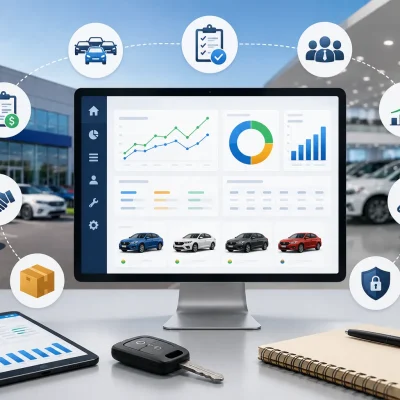
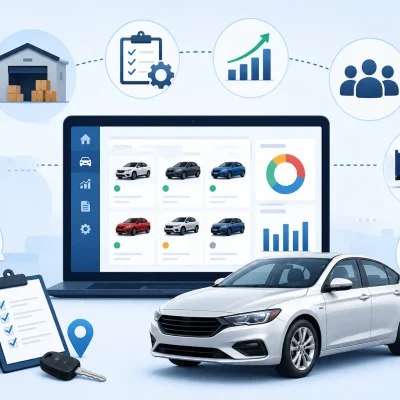
A modern dealer management system brings every department together under one platform.
Some of the biggest advantages include:
Better Inventory Control
Real-time inventory tracking prevents duplicate bookings and improves vehicle availability across branches.
Faster Sales Process
Sales executives can check inventory, create quotations, book vehicles, and coordinate deliveries without switching between multiple applications.
Improved Financial Accuracy
Integrated dealership accounting software reduces manual data entry while improving invoice accuracy, helping dealerships maintain GST compliance and generate tax-ready records.
Better Customer Experience
Customers receive quicker responses because sales, finance, and service teams work with the same information.
Data-Driven Decision Making
Management dashboards provide insights into sales performance, inventory turnover, profitability, customer retention, and employee productivity.
See how DealerSetu manages inventory, CRM, finance, and service from one platform.
Why Many Dealerships Use Both CRM and DMS
The discussion should not always be CRM versus DMS.
For larger dealership groups, the ideal approach is often CRM integrated with a Dealer Management System.
CRM manages customer acquisition.
DMS manages dealership operations.
When both systems share information automatically, dealerships eliminate duplicate work while creating a better customer experience.
For example:
- A customer submits an enquiry through the dealership website.
- The CRM assigns the lead to a sales executive.
- Once the customer confirms the booking, the DMS checks inventory availability.
- Finance processes the payment.
- Accounting generates the invoice.
- Delivery is scheduled.
- Future service reminders are recorded.
Every department works together without manually transferring information between systems.
How DealerSetu Brings Everything Together
Many dealerships prefer managing operations through a single integrated platform instead of purchasing multiple software solutions.
DealerSetu combines Dealer CRM, inventory management, finance, accounting, service workshop, warranty management, approvals, reporting, and multi-branch management into one comprehensive platform.
Instead of maintaining separate applications for different departments, dealership teams access one centralized system where information updates in real time.
This reduces manual work, improves collaboration, and provides management with complete visibility across the business.
For dealerships planning long-term growth, an integrated solution often delivers better operational efficiency than maintaining multiple standalone systems.
Practical Example
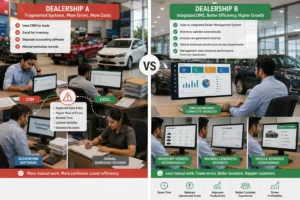
Imagine two dealerships of similar size.
Dealership A
- Uses CRM for leads
- Excel for inventory
- Separate accounting software
- Manual workshop records
Employees spend time entering the same information into different systems, increasing the risk of errors.
Dealership B
Uses an integrated Dealer Management System.
Inventory updates automatically.
Invoices are generated instantly.
Vehicle bookings synchronize across departments.
Management views business performance from one dashboard.
The second dealership saves time, reduces operational costs, and provides a more consistent customer experience.
How to Choose the Right Software for Your Dealership
Selecting dealership software is a long-term business decision. The right platform should not only solve today’s operational challenges but also support your dealership as it grows.
Before making a decision, evaluate the software using the following checklist.
1. Understand Your Business Requirements
Start by identifying the problems you want to solve.
Ask questions such as:
- Are leads getting missed?
- Is inventory managed manually?
- Are different departments using different software?
- Do you need better financial reporting?
- Are multiple branches difficult to manage?
The answers will help determine whether you need a CRM, a Dealer Management System, or an integrated solution.
2. Look Beyond Basic Features
Many software providers advertise long feature lists, but not every feature delivers business value.
Instead, focus on capabilities that improve daily operations, including:
- Dealer CRM
- Vehicle inventory management
- Finance and insurance
- Dealership accounting
- GST billing
- Workshop management
- Spare parts management
- Warranty tracking
- Approval workflows
- Multi-branch management
- Real-time dashboards
- Mobile accessibility
The software should simplify work instead of adding complexity.
3. Consider Scalability
Your dealership may have one showroom today, but expansion plans can quickly change software requirements.
Choose a solution that supports:
- Additional branches
- More employees
- Larger inventory
- Multiple brands
- Higher transaction volumes
Replacing software every few years is expensive and disruptive.
4. Check Integration Capabilities
A dealership uses several business tools, including payment gateways, OEM portals, messaging platforms, and accounting systems.
Your software should integrate with these tools to eliminate duplicate work and improve data accuracy.
Good integrations also provide a better experience for both employees and customers.
5. Evaluate Reporting and Dashboards
Good decisions require accurate data.
The software should provide reports for:
- Vehicle sales
- Inventory aging
- Branch performance
- Customer enquiries
- Employee productivity
- Financial performance
- Service revenue
A strong reporting dashboard allows management to identify opportunities before they become problems.
Common Mistakes to Avoid
Many dealerships invest in software without carefully evaluating their long-term needs.
Avoid these common mistakes:
Choosing software based only on price
The cheapest option often lacks the features required as the business grows.
Buying multiple disconnected systems
Using separate tools for CRM, accounting, inventory, and reporting increases manual work and creates inconsistent data.
Ignoring employee training
Even the best software delivers limited value if employees are not trained to use it effectively.
Focusing only on sales
Sales are important, but inventory, finance, workshop operations, and reporting have an equal impact on profitability.
Not planning for future growth
Choose software that supports expansion instead of limiting it.
Final Thoughts
The debate between CRM and DMS is not about choosing one over the other. It is about understanding what your dealership needs today and what it will need in the future.
A CRM helps organize customer relationships and improve sales activities. A Dealer Management System manages the broader dealership operation, including inventory, finance, accounting, workshops, reporting, and employee management.
For growing dealerships, managing multiple disconnected systems often creates unnecessary complexity. An integrated platform provides a single source of truth, improves collaboration between departments, and supports better business decisions.
DealerSetu is designed with this approach in mind. It combines Dealer CRM, inventory management, accounting, finance, workshop operations, reporting, and multi-branch management into one platform, helping dealerships simplify operations while improving visibility across the business.
If your dealership is evaluating new software, start by identifying the operational challenges that consume the most time and resources. The right solution should not only solve those challenges but also support your business as it continues to grow.
Frequently Asked Questions
1. What is the difference between CRM and DMS for auto dealers?
A CRM focuses on lead management, customer communication, and sales follow-ups. A Dealer Management System manages the entire dealership, including inventory, accounting, finance, workshops, reporting, and customer management.
2. Can a dealership use both CRM and DMS?
Yes. Many dealerships integrate CRM with a Dealer Management System so customer enquiries, vehicle inventory, sales, finance, and service operations work together seamlessly.
3. Which is better for a growing dealership?
A Dealer Management System is generally the better choice for growing dealerships because it supports multiple departments and scales with business expansion.
4. Does a Dealer Management System include CRM?
Most modern Dealer Management Systems include built-in Dealer CRM functionality along with inventory management, accounting, reporting, and workshop management.
5. Is Dealer Management Software suitable for multi-branch dealerships?
Yes. Modern dealership management software provides centralized control over inventory, employees, financial reports, and operations across multiple branches.
6. How does a DMS improve dealership profitability?
A DMS reduces manual work, improves inventory accuracy, streamlines financial processes, enhances reporting, and helps management make better business decisions.
7. What should I look for before buying dealership software?
Evaluate features such as inventory management, Dealer CRM, accounting, GST billing, reporting, workshop management, scalability, integrations, security, customer support, and ease of use.