
CRM vs DMS for Auto Dealers: Which One Does Your Dealership Really Need? Many automobile dealerships begin their digital journey by investing in software. Some start with a Customer Relationship Management (CRM) system to organize leads and improve follow-ups. Others invest in a Dealer Management System (DMS) to manage inventory, billing, accounting, and day-to-day operations. The challenge begins when dealership owners assume that both systems perform the same role. Although CRM and DMS work closely together, they solve very different business problems. Choosing the wrong software can create operational gaps, duplicate work, and unnecessary expenses. Understanding how each system works helps dealerships invest in technology that supports both immediate requirements and future growth. This guide explains the differences between CRM and DMS, where each solution adds value, and why many successful dealerships eventually use both as part of a connected dealership ecosystem. What is a CRM for Auto Dealers? A Customer Relationship Management system focuses on customers and sales activities. Its primary objective is to help dealerships attract leads, manage enquiries, improve follow-ups, and increase vehicle sales. A good dealer CRM software stores customer information in one place, making it easier for sales teams to understand buyer preferences and maintain communication throughout the sales journey. Typical CRM features include: Lead capture from websites and campaigns Sales enquiry management Follow-up reminders Customer communication history Test drive scheduling Sales pipeline management Lead assignment Customer retention activities For dealerships investing in digital marketing, a CRM ensures that every lead receives timely attention. What is a Dealer Management System (DMS)? A dealer management system is designed to manage the complete operations of an automobile dealership. While CRM focuses on customer relationships, a DMS manages the business behind every sale. Modern dealership management software connects multiple departments on one platform, allowing dealerships to operate efficiently without relying on disconnected systems. A typical DMS includes: Vehicle inventory management Sales management Dealer CRM Finance and Insurance Accounting GST billing Workshop management Spare parts inventory Warranty tracking Multi-branch management Employee performance Reports and dashboards Instead of switching between multiple applications, dealership teams work from one centralized system. CRM vs DMS: Understanding the Core Difference The easiest way to understand the difference is by looking at their primary purpose. A CRM answers the question: “How can we sell more vehicles?” A DMS answers the question: “How do we manage the entire dealership efficiently?” CRM is primarily customer-focused. DMS is business-focused. CRM helps generate revenue through better customer engagement. DMS helps improve profitability by streamlining operations across departments. Rather than replacing each other, both systems complement one another. Feature Comparison Feature CRM DMS Lead Management ✔ ✔ Customer Database ✔ ✔ Vehicle Inventory ✘ ✔ Billing & Invoicing ✘ ✔ GST Management ✘ ✔ Accounting ✘ ✔ Service Workshop ✘ ✔ Spare Parts ✘ ✔ Warranty Management ✘ ✔ Multi-Branch Management Limited ✔ Business Reporting Sales Reports Complete Dealership Reports The comparison clearly shows that CRM covers only one part of dealership operations, while a Dealer Management System manages the entire business. Book Your DealerSetu Demo Today When is CRM Enough? For some businesses, investing in CRM first makes sense. Examples include: New dealerships with limited operations Independent used car dealers Vehicle brokers Sales-focused businesses without workshops Dealerships outsourcing accounting In these situations, the priority is improving customer acquisition and managing enquiries efficiently. However, as operations grow, CRM alone often becomes insufficient. When Does a Dealership Need a DMS? As dealerships expand, they begin managing larger inventories, additional employees, finance operations, workshops, spare parts, and multiple branches. At this stage, relying only on CRM creates operational challenges. A car dealership management software becomes essential when dealerships need to: Track inventory in real time Generate GST invoices Manage finance approvals Handle workshop operations Monitor employee productivity Produce management reports Control multiple branches Improve inventory turnover These operational capabilities fall outside the scope of a traditional CRM system. Indian Dealerships Face Different Challenges The Indian automobile market is highly competitive and operationally complex. According to the Society of Indian Automobile Manufacturers (SIAM), India is one of the world’s largest automobile markets, making efficient dealership operations increasingly important. Dealerships often manage: High inventory volumes Finance partners Insurance partners GST compliance Multiple OEM requirements Regional warehouses Branch transfers High customer expectations Managing these processes through separate software applications often creates duplicate work and reporting inconsistencies. This is one reason why many dealerships across India are moving toward integrated automobile dealership management software instead of relying solely on standalone CRM platforms. Should You Choose CRM or DMS? The answer depends on your dealership’s size, operational complexity, and long-term business goals. A dealership that only wants to improve lead management and customer follow-ups may find a CRM sufficient during the early stages. However, once inventory grows, departments expand, and financial processes become more complex, a CRM alone cannot manage the entire business. A Dealer Management System becomes essential when different teams need access to the same information in real time. Sales, inventory, finance, workshop, customer service, and management all benefit from working on a single platform instead of multiple disconnected applications. The decision should not be based on software cost alone. It should focus on operational efficiency, customer experience, and future scalability. CRM vs DMS: Which One Fits Your Dealership? Business Requirement CRM DMS Capture online leads ✔ ✔ Manage customer enquiries ✔ ✔ Sales follow-up reminders ✔ ✔ Vehicle inventory management ✘ ✔ Dealer inventory management system ✘ ✔ Vehicle booking Limited ✔ Delivery management ✘ ✔ Finance and insurance ✘ ✔ GST billing ✘ ✔ Dealership accounting ✘ ✔ Workshop management ✘ ✔ Spare parts inventory ✘ ✔ Warranty management ✘ ✔ Multi-branch operations Limited ✔ Management dashboard Limited ✔ Employee performance tracking ✘ ✔ For most growing dealerships, a DMS delivers greater long-term value because it supports every department instead of focusing only on sales. Common Challenges Faced by Dealerships Using Only CRM Many dealerships begin with a CRM because it helps organize customer enquiries. While this improves sales processes, operational
How Vehicle Inventory Management Software Reduces Dead Stock and Overstocking
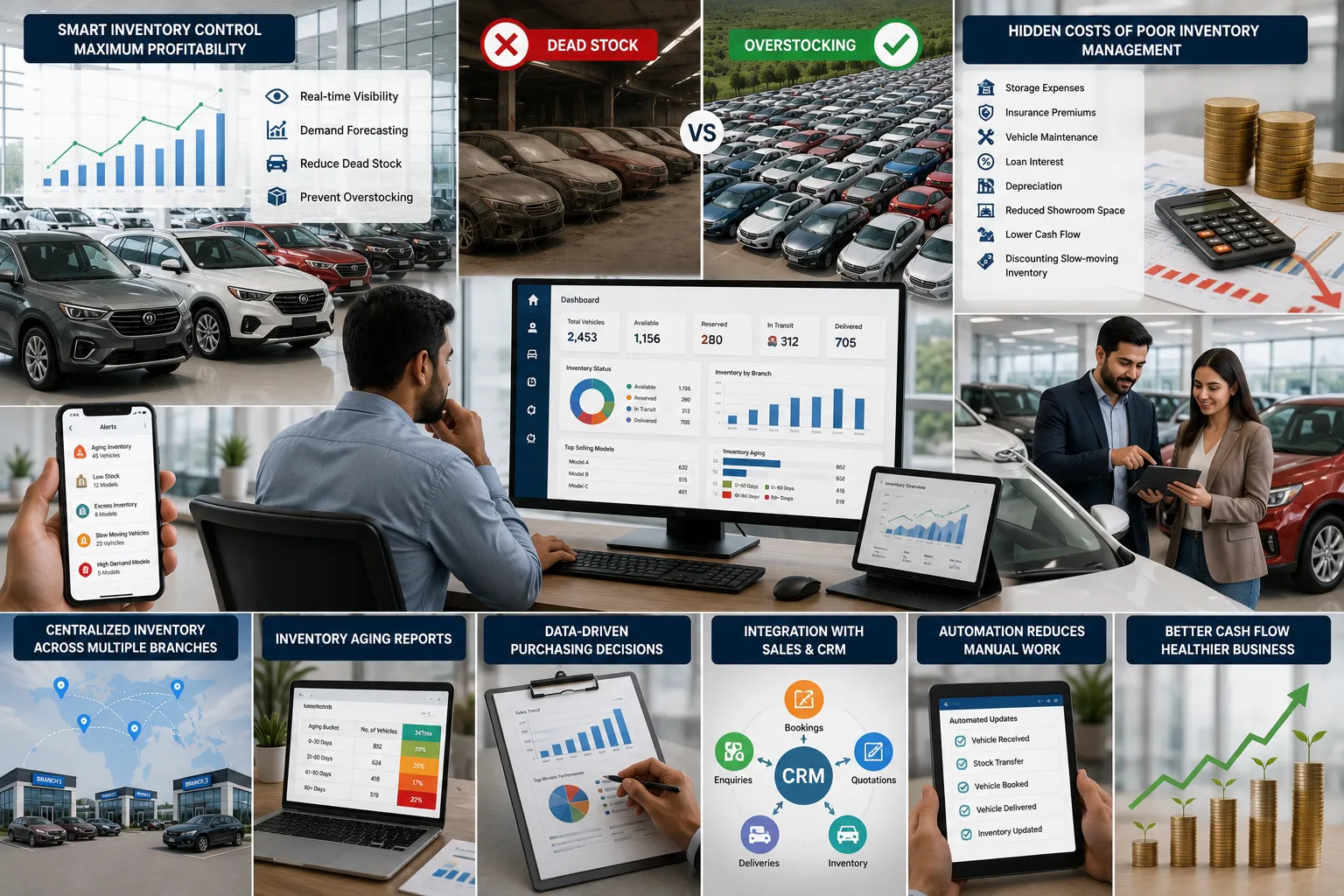
For every automobile dealership, inventory is one of the largest business investments. Every vehicle sitting in the showroom or stockyard represents capital that should generate revenue as quickly as possible. However, many dealerships struggle with two common inventory challenges: dead stock and overstocking. Dead stock refers to vehicles that remain unsold for long periods, while overstocking occurs when dealerships purchase more inventory than market demand requires. Both problems tie up cash flow, increase storage costs, and reduce overall profitability. These issues often arise because dealerships rely on manual inventory tracking, outdated spreadsheets, or disconnected systems that provide limited visibility into stock movement and customer demand. Fortunately, modern vehicle inventory management software helps dealerships overcome these challenges by providing real-time inventory visibility, demand forecasting, automated stock monitoring, and intelligent reporting. Instead of making purchasing decisions based on assumptions, dealerships can rely on accurate data to maintain the right inventory levels. Let’s understand how the right inventory management solution can significantly reduce dead stock and prevent overstocking. Understanding Dead Stock in Automobile Dealerships Dead stock refers to vehicles that remain unsold for an extended period. These vehicles occupy valuable showroom space while continuously increasing operational costs. Several factors contribute to dead stock, including inaccurate demand forecasting, changing customer preferences, seasonal fluctuations, and poor inventory planning. Every additional day a vehicle remains unsold increases expenses related to insurance, maintenance, financing, depreciation, and storage. Over time, dealerships may need to offer heavy discounts to clear aging inventory, directly impacting profit margins. Without proper inventory monitoring, identifying slow-moving vehicles becomes difficult until financial losses have already occurred. What Causes Overstocking? Overstocking happens when dealerships purchase more vehicles than customers are likely to buy within a reasonable period. Many dealerships order inventory based on assumptions instead of actual sales trends. Some also purchase excess stock during promotional offers or to prepare for anticipated demand that never materializes. Common reasons for overstocking include: Lack of sales forecasting Poor inventory visibility Duplicate vehicle purchases Inefficient stock transfers Limited reporting Seasonal demand miscalculations Overstocking not only increases carrying costs but also limits the dealership’s ability to invest in faster-moving vehicle models. The Hidden Cost of Poor Inventory Management Many dealership owners only consider the purchase price of a vehicle when calculating inventory costs. In reality, every unsold vehicle continues to generate additional expenses. These costs include: Storage expenses Insurance premiums Vehicle maintenance Loan interest Depreciation Reduced showroom space Lower cash flow Discounting slow-moving inventory Without an effective dealer inventory management system, these hidden costs continue to grow while reducing overall profitability. Real-Time Inventory Visibility Improves Decision Making One of the biggest advantages of vehicle inventory management software is complete visibility into inventory. Instead of manually checking spreadsheets or contacting multiple branches, dealership managers can instantly see: Available vehicles Reserved vehicles Delivered vehicles In-transit inventory Aging inventory Branch-wise stock Real-time visibility enables dealerships to make informed purchasing decisions and avoid ordering vehicles that are already available within the organization. Better Demand Forecasting One of the primary reasons dealerships accumulate dead stock is inaccurate forecasting. Modern automobile inventory management software analyzes historical sales data, seasonal buying patterns, regional demand, and inventory turnover rates to predict future inventory requirements. For example, if SUVs consistently sell faster during festive seasons while premium sedans move more slowly, dealership managers can adjust purchasing strategies accordingly. Instead of relying on guesswork, dealerships use actual business data to optimize inventory levels. Faster Inventory Turnover Inventory turnover is one of the most important performance indicators for any dealership. Higher turnover means vehicles are sold quickly, reducing financing costs and improving cash flow. A modern vehicle inventory tracking software highlights slow-moving inventory before it becomes dead stock. Managers can launch promotional campaigns, transfer vehicles between branches, or adjust pricing strategies to improve sales. Faster inventory turnover directly contributes to healthier business performance. Centralized Inventory Across Multiple Branches Many dealership groups operate multiple showrooms across different cities. Without centralized inventory management, one branch may overstock a particular model while another branch struggles to meet customer demand. A cloud-based dealership inventory management software allows managers to monitor inventory across every branch from a single dashboard. Instead of purchasing additional vehicles unnecessarily, dealerships can simply transfer inventory between locations, reducing overstocking while improving vehicle availability. Automated Stock Alerts Manual inventory monitoring often causes managers to react too late. Modern vehicle stock management software automatically sends alerts for: Aging inventory Low stock Excess inventory Slow-moving vehicles High-demand models These notifications help dealerships take timely action before inventory problems become costly. Book Your DealerSetu Demo Today Inventory Aging Reports Help Reduce Dead Stock One of the most valuable features of vehicle inventory management software is inventory aging analysis. Every vehicle in stock is categorized based on how long it has remained in the dealership. Managers can quickly identify vehicles that have been in inventory for 30, 60, 90, or even 180 days. Instead of waiting until these vehicles become difficult to sell, dealerships can take proactive measures such as running promotional offers, adjusting prices, increasing marketing efforts, or transferring inventory to another branch where demand is higher. Regular inventory aging reports help dealerships maintain healthier stock levels while reducing unnecessary carrying costs. Data-Driven Purchasing Decisions Successful dealerships rely on data rather than assumptions. A modern automotive inventory management solution provides detailed reports that help managers understand: Best-selling vehicle models Slow-moving inventory Seasonal buying trends Branch-wise sales performance Vehicle turnover rates Purchase history These insights help dealerships order the right vehicles in the right quantities. Instead of overstocking popular assumptions, purchasing teams can align inventory with actual customer demand. Integration with Sales and CRM Inventory management becomes even more effective when connected with sales and customer relationship management. Modern inventory management for car dealerships integrates inventory with CRM, enquiries, bookings, quotations, and vehicle deliveries. When a vehicle is booked or sold, inventory updates automatically without requiring manual intervention. Sales teams can instantly check vehicle availability while speaking with customers, reducing booking errors and improving response times. This integration also allows managers to understand